
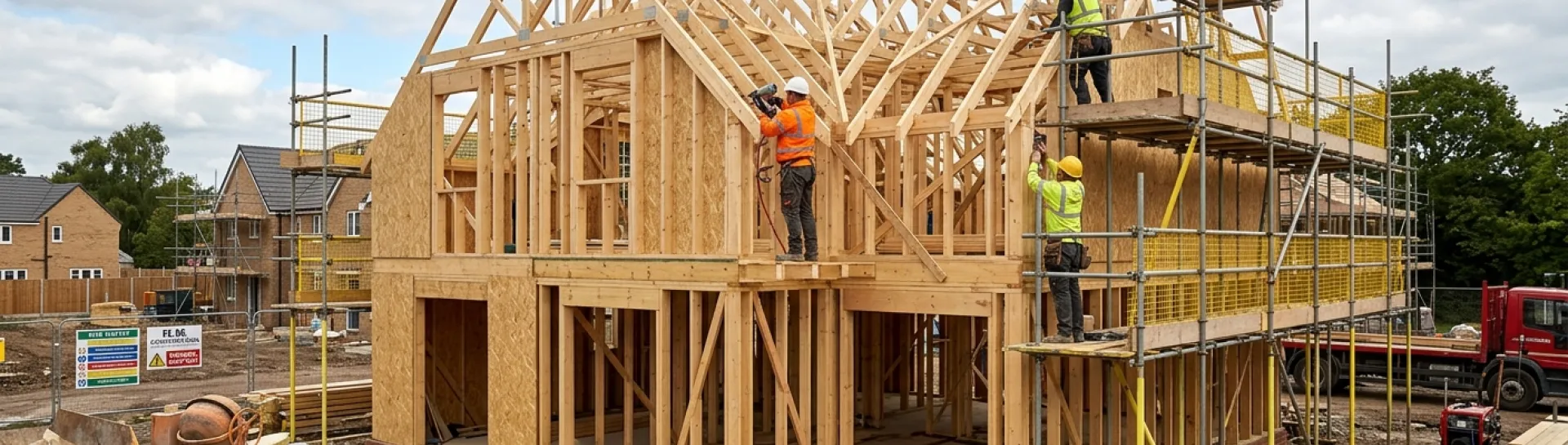
Timber Frame
Insulation for timber frame construction — specified with confidence.
Timber frame has become one of the most popular construction methods in the UK, and it's easy to see why. It's fast to construct, resource-efficient, and when it's well designed, capable of delivering excellent thermal performance. But as energy standards tighten and the industry pushes further towards fabric-first design, getting the insulation strategy right has become more important than ever.
The challenge with timber frame isn't just about hitting a U-value. It's about managing thermal bridging through the structural members, achieving effective airtightness at junctions, and integrating the insulation in a way that works practically within the panel system. These aren't problems that can be solved with a simple product swap — they need considered design and the right technical support.
Faster Build Programmes, Greater Predictability
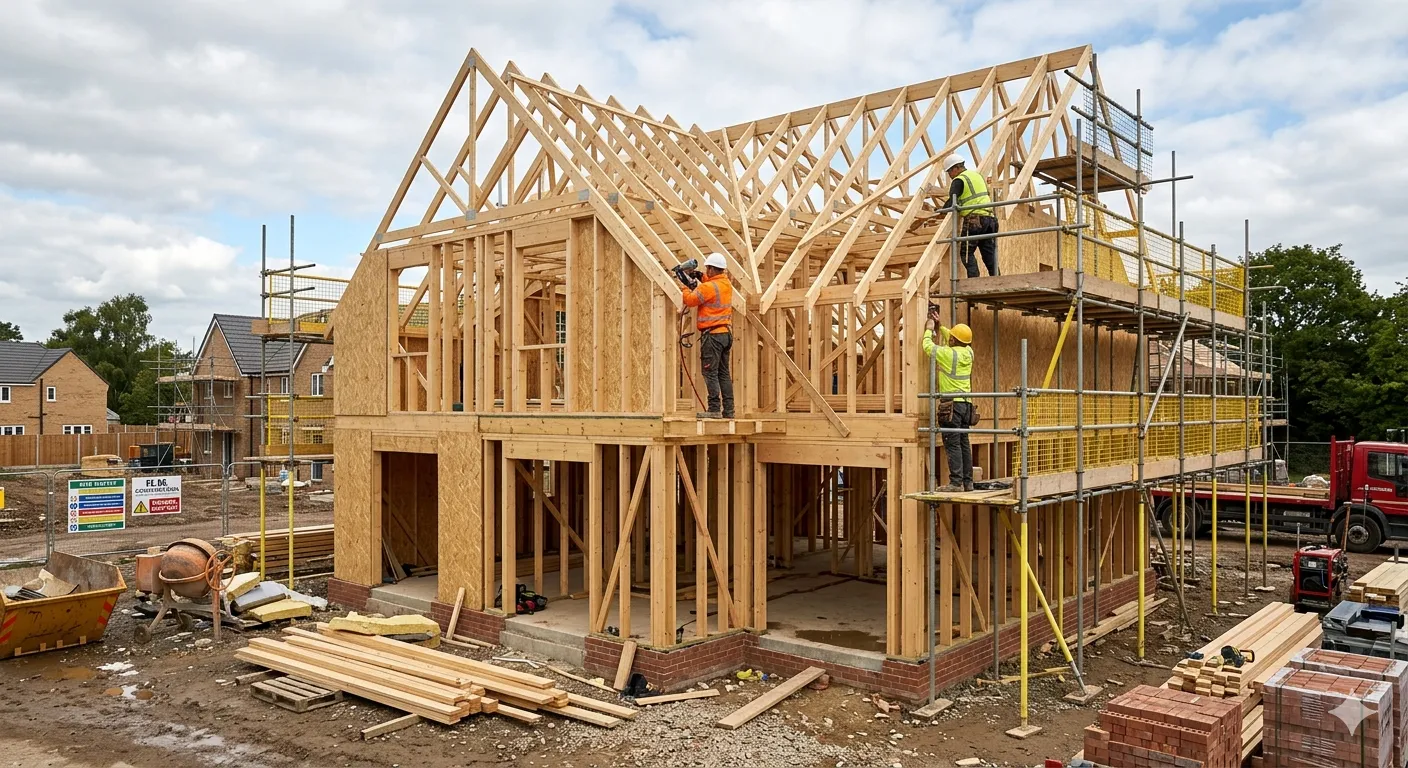
Programme certainty is one of timber frame's most compelling advantages. Because panels are manufactured offsite under controlled conditions, on-site installation is significantly faster and far less exposed to the unpredictability of British weather than traditional masonry construction.
That streamlined process eases labour demand, compresses build schedules and helps projects reach watertight stage sooner. In many cases, the structural frame can be erected in days rather than weeks - creating a cleaner handover to internal trades and reducing costly programme overlap.
For developers working to tight delivery targets, timber frame offers a more controlled and predictable route from design to completion.
Supporting Modern Methods of Construction
Timber frame sits at the heart of the UK's growing adoption of Modern Methods of Construction (MMC). Digital modelling, precision manufacturing and BIM integration are reshaping the way timber frame projects are designed, coordinated and delivered with advanced software platforms enabling detailed 3D coordination, automated fabrication outputs and closer collaboration between architects, engineers and manufacturers.
The result is fewer errors on site, better coordination across disciplines and construction workflows that are more efficient from the outset.
PIR's place in timber frame's sustainability story
Timber frame is often chosen partly for its environmental credentials, lower embodied carbon than masonry, sustainably sourced timber, and a less wasteful construction process. But the insulation strategy matters too, and PIR has a stronger sustainability story than it's sometimes given credit for.
Its high thermal efficiency means you achieve a given U-value with less material and less thickness than many alternatives, reducing overall material volume, embodied carbon, and transport impact. And the operational energy picture is just as important: a well-insulated building uses significantly less energy over its lifetime, and those long-term carbon savings will, in most cases, comfortably outweigh the embodied carbon of the insulation itself.
Timber frame and PIR aren't in tension ecologically. Used well, they're complementary: a renewable structural system paired with a high-performance insulation that earns its place through efficiency, longevity, and an improving end-of-life pathway.

The role of rigid insulation in timber frame
Cavity insulation within the timber frame panel does the heavy lifting on thermal resistance, but it has an inherent limitation: it can't address heat loss through the structural timber itself. Studs, rails, noggins and other framing members all conduct heat more readily than the insulation between them. In a highly specified timber frame building, this thermal bridging effect can have a meaningful impact on the overall wall U-value — sometimes the difference between meeting a target comfortably and falling short.
The solution is a continuous layer of rigid insulation applied to the outside face of the frame. By wrapping the structure rather than just filling between it, rigid insulation breaks the thermal bridge and allows the wall build-up to perform closer to its theoretical potential. The choice of product matters here: thickness, thermal conductivity and compressive strength all need to be matched carefully to the panel system, the cladding specification and the overall U-value target.
The Gradient solution
This is where Gradient's technical expertise adds real value. We work with timber frame designers, manufacturers and contractors to specify the right rigid insulation solution for each project - whether that's a PIR board, a thinner vacuum insulation panel where space is constrained, or a hybrid approach that balances performance with practicality.
Our team can run U-value calculations, model thermal bridging scenarios and provide the technical backup needed to give specifiers confidence at every stage. Boards can also be supplied cut-to-size for offsite manufacture, helping reduce factory processing time, minimise waste and improve installation efficiency.